What License Is Required for a PCD Pharma Franchise in India?
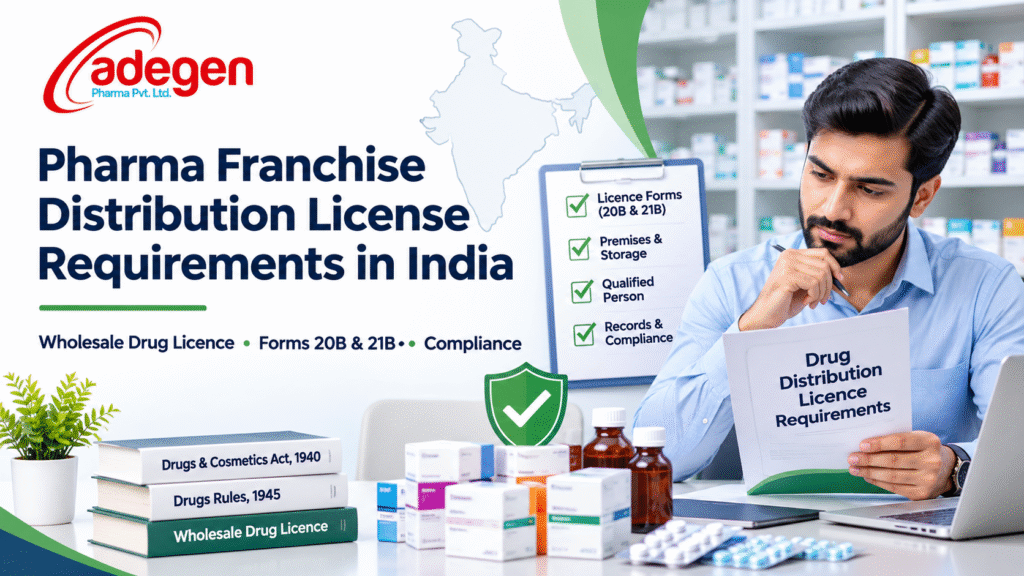
A PCD pharma franchise involving wholesale stocking, sale or distribution of regulated medicines generally requires an appropriate wholesale drug licence. Form 20B covers specified general drug categories, while Form 21B covers relevant Schedule C and C(1) drugs. The distributor must also satisfy applicable premises, competent-person, storage and documentation requirements.
The correct licence depends on the medicines being handled and the nature of the proposed business.
The relevant regulatory framework includes the Drugs and Cosmetics Act, 1940, the Drugs Rules, 1945 and subsequent amendments.
Applications are generally processed by the competent State or Union Territory drug licensing authority.
Is a Drug License Mandatory for a PCD Pharma Franchise?
A drug licence is generally mandatory when the franchise associate intends to stock, sell or distribute regulated medicines by wholesale.
A PCD pharma franchise is a commercial arrangement between a pharmaceutical company and a business associate. It may cover product supply, geographical territory, promotional material and payment terms.
However, these commercial arrangements do not independently authorise the franchise associate to conduct regulated pharmaceutical wholesale activities.
For example, if you plan to purchase medicines from a pharmaceutical company, maintain inventory at your premises and supply authorised trade customers, you should verify the wholesale drug licences required for those activities.
Some marketing-only arrangements may involve different obligations where no regulated stocking, sale or distribution occurs. The actual business model must be assessed before determining the applicable licensing requirements.
Types of Wholesale Drug Licenses for Pharma Franchise Distribution
One of the most important aspects of pharma franchise distribution license requirements in India is selecting the correct licence category.
Different licence forms apply to different categories of medicines. Forms 20B and 21B are particularly relevant to pharmaceutical wholesale businesses.
| Form | Purpose | Important Detail |
|---|---|---|
| Form 19 | Application for specified drug sale licences | Application form, not the final wholesale authorisation |
| Form 20B | Wholesale sale, stocking or distribution of drugs other than those specified in Schedules C, C(1) and X | Relevant to many general medicine wholesale activities |
| Form 21B | Wholesale sale, stocking or distribution of Schedule C and C(1) drugs, excluding Schedule X | Applies to relevant scheduled drug categories |
Businesses dealing with specially regulated medicines, including Schedule X drugs, must verify the separate licences and additional conditions applicable to those categories.
Form 20B Wholesale Drug License
Form 20B authorises relevant wholesale activities involving drugs other than those specified in Schedules C, C(1) and X, subject to its conditions and the applicable rules.
A distributor should verify whether its proposed pharmaceutical product range falls within this licence category.
Form 21B Wholesale Drug License
Form 21B covers relevant wholesale activities involving drugs specified in Schedules C and C(1), excluding Schedule X.
Depending on the product portfolio, a wholesale business may require both Form 20B and Form 21B authorisations.
Difference Between Form 19 and Form 20B
Form 19 is used for applying for specified drug sale licences. Form 20B is the licence issued for a particular category of wholesale activity.
In simple terms, the application form and the licence document serve different purposes.
Applicants should follow the forms and procedures currently prescribed by their relevant licensing authority.
Eligibility Criteria for a Wholesale Drug License in India
Before obtaining a wholesale drug licence, the applicant must satisfy the applicable requirements concerning the business premises, competent personnel and regulatory documentation.
Suitable Commercial Premises
The proposed premises must satisfy the relevant statutory requirements and provide suitable arrangements for pharmaceutical storage and operations.
The licensing authority may inspect the premises before issuing the authorisation.
Eligible Competent Person
A wholesale drug business must meet the applicable conditions relating to a competent person responsible for supervising the relevant wholesale activities.
The person must satisfy the qualifications or experience requirements prescribed under the applicable rules.
Proper Medicine Storage
Medicines should be stored according to their approved labelling and any applicable regulatory requirements.
Some pharmaceutical products require special handling or temperature-control arrangements.
Business and Identity Documentation
The applicant must provide the documents required to establish the business identity, legal possession of the premises and eligibility for the requested licence.
Minimum Area Required for a Wholesale Drug License
Premises area is an important part of drug licensing eligibility.
Under the relevant provisions of the Drugs Rules, 1945, the following minimum area requirements commonly apply:
| Business Activity | Minimum Area |
|---|---|
| Wholesale licence under Form 20B or 21B | 10 square metres |
| Combined retail and wholesale licences under the relevant provisions | 15 square metres |
These are minimum area requirements under the specified provisions and do not automatically establish that every premises is suitable.
Other conditions relating to storage, layout, personnel and product categories may apply.
Applicants should confirm the current requirements with their State Drug Control Department before finalising a business premises.
Who Can Be a Competent Person for a Wholesale Drug License?
For the relevant wholesale licence categories, the Drugs Rules recognise different qualification and experience routes for a competent person.
These include:
- A registered pharmacist.
- A person who has passed matriculation or an equivalent recognised examination and has four years of the prescribed experience dealing with the sale of drugs.
- A degree holder from a recognised university with one year of the prescribed experience dealing with drugs.
The licensing authority must be satisfied that the proposed person meets the applicable conditions.
A pharmacist is therefore one recognised eligibility route, but the relevant wholesale licensing framework also recognises certain alternative qualification-and-experience routes.
Applicants should verify current requirements before appointing a competent person.
Important 2026 Update: Competent Person Reporting Requirements
Pharmaceutical distributors should be aware of the Drugs (Amendment) Rules, 2026, published through Gazette notification G.S.R. 135(E).
The amendment introduced additional provisions concerning competent-person supervision and reporting under specified drug sale licence forms.
For relevant wholesale licences, changes in the competent person must be reported to the licensing authority within one month of the change.
The amendment also specifies competent-person supervision information in certain licence forms.
This is important because obtaining a licence is not the end of a distributor’s regulatory responsibilities.
If a competent person leaves the business or is replaced, the licensee must follow the applicable notification and supervision requirements.
For the official notification, refer to the CDSCO Gazette Notifications and locate G.S.R. 135(E), dated 16 February 2026.
Documents Required for Pharma Franchise Distribution License in India
Applicants should prepare their documentation before beginning the licensing process.
The exact checklist varies according to the state, business structure, licence category and proposed pharmaceutical activities.
Commonly requested documents may include:
- Completed application in the prescribed form.
- Applicant’s identity and address proof.
- Business registration or constitution documents, where applicable.
- PAN and relevant tax registration details.
- Premises ownership documents or a valid rental agreement.
- Site plan or premises layout, where required.
- Competent person’s qualification certificates.
- Relevant experience certificates.
- Appointment letters and declarations, where required.
- Details of pharmaceutical storage arrangements.
- Proof of payment of prescribed government fees.
- Other documents required by the licensing authority.
Submitting complete and accurate documents can help avoid unnecessary queries during the application process.
How to Apply for a Wholesale Drug License in India
The drug licensing application process depends on the state or Union Territory in which the business will operate.
Step 1: Determine the Correct License
Identify the pharmaceutical products you intend to stock and confirm which licence forms apply to the proposed activities.
Step 2: Check the State Licensing Portal
Visit the appropriate government licensing website and review the available services.
Some authorities use the Online National Drugs Licensing System or other authorised online application systems.
Step 3: Arrange the Required Premises
Ensure that the location meets the applicable minimum area and storage requirements.
Obtain the required premises documents.
Step 4: Identify an Eligible Competent Person
Arrange the qualification, experience and appointment documents required for the competent person.
Step 5: Submit Your Application
Complete the prescribed form, upload the required documents and provide accurate business information.
Step 6: Pay the Applicable Government Fees
Pay the prescribed charges through the authorised payment method.
Use the official portal to verify the current fee structure.
Step 7: Complete Verification and Inspection
The licensing authority may review documents and inspect the premises to verify compliance.
Step 8: Receive the License
Begin regulated wholesale activities only after the necessary authorisation has been issued and the applicable conditions have been satisfied.
Submitting an application alone does not provide permission to commence pharmaceutical wholesale distribution.
How Much Does a Pharma Distribution License Cost in India?
The total cost of setting up a pharmaceutical distribution business includes more than the statutory licence application fee.
Expenses may include government fees, premises, storage arrangements, documentation assistance, business registrations and operational setup.
There is no single reliable total investment figure for every pharmaceutical franchise applicant.
Applicants should check the current government fee schedule and prepare a separate budget for business infrastructure and working capital.
How Long Does It Take to Get a Wholesale Drug License?
Approval time can vary according to the relevant licensing authority, completeness of the application, verification process and inspection requirements.
Incomplete documents or deficiencies in premises arrangements may cause additional delays.
Applicants should check the official service timelines and application tracking facilities provided by their state licensing authority.
No private pharmaceutical company can independently guarantee approval of a government drug licence.
Wholesale Drug License vs PCD Pharma Franchise Agreement
A common misunderstanding among new entrepreneurs is that signing a franchise agreement automatically grants permission to distribute pharmaceutical medicines.
In reality, the two documents have different purposes.
| Factor | Wholesale Drug License | PCD Franchise Agreement |
|---|---|---|
| Purpose | Authorises specified regulated pharmaceutical activities | Establishes commercial distribution terms |
| Issued By | Competent government authority | Agreed between the supplier and franchise associate |
| Main Conditions | Licensing, premises, personnel and compliance | Products, prices, orders, territory and business responsibilities |
| Can Replace the Other? | No | No |
A drug licence does not itself establish a partnership with a pharmaceutical company. Similarly, a franchise agreement does not replace mandatory government authorisations.
Compliance Responsibilities After Receiving a Drug License
Wholesale pharmaceutical distributors must maintain compliance after obtaining the required licence.
Maintain Proper Purchase and Sale Records
Keep appropriate invoices and transaction records in accordance with applicable requirements.
Follow Storage Instructions
Store pharmaceutical products according to their approved labelling and required environmental conditions.
Monitor Medicine Expiry Dates
Maintain batch-wise inventory controls and prevent inappropriate distribution of expired medicines.
Purchase Products from Authorised Sources
Verify suppliers and retain relevant purchasing documentation.
Manage Product Complaints and Recalls
Establish a procedure to identify and respond to product quality complaints or recall notifications.
Report Relevant Changes
Keep the licensing authority informed of reportable changes, including competent-person changes within the applicable timeframe.
Common Mistakes When Applying for a Pharma Distribution License
Understanding the Pharma Franchise Distribution License Requirements in India also helps applicants avoid common problems.
Selecting the Wrong Licence Form
Different licence categories apply to different medicines. Applying for the wrong licence can create compliance and operational difficulties.
Using Unsuitable Premises
Check the relevant area and storage requirements before finalising a property.
Providing Incomplete Documents
Missing premises documents or insufficient competent-person records can delay the application.
Starting Wholesale Activities Before Approval
A submitted application is not equivalent to an issued licence.
Ignoring Licence Conditions After Approval
Distributors must continue to comply with applicable storage, documentation, supervision and reporting requirements.
Start Your PCD Pharma Franchise Business with Adegen Pharma
Once you understand the relevant licensing requirements, the next step is evaluating pharmaceutical suppliers and selecting products suitable for your business.
Adegen Pharma Pvt. Ltd. is based in Sector 20, Panchkula, Haryana, and provides information about pharmaceutical products and PCD franchise business opportunities.
The company’s published portfolio includes tablets, capsules, softgel capsules, syrups, dry syrups, suspensions, injections, infusions, drops and various topical formulations.
Prospective distributors can review its PCD Pharma Franchise services and request information about the current product catalogue.
Before entering a franchise arrangement, discuss product availability, manufacturer details, purchase conditions and your proposed market.
Businesses considering a different pharmaceutical business model can also explore Adegen Pharma’s Third-Party Manufacturing services.
Adegen Pharma’s commercial services do not replace any statutory drug licence required for the distributor’s activities.
Frequently Asked Questions About Pharma Franchise Distribution License Requirements in India
1. What license is required for a PCD pharma franchise in India?
A pharmaceutical franchise business involving wholesale stocking, sale or distribution of regulated medicines generally requires the appropriate wholesale drug licence. Forms 20B and 21B are commonly relevant, depending on the drug category. The distributor must also comply with applicable premises, competent-person and documentation conditions.
2. What is the difference between Form 20B and Form 21B?
Form 20B covers relevant wholesale activities involving drugs other than those specified in Schedules C, C(1) and X. Form 21B applies to relevant wholesale activities involving Schedule C and C(1) drugs, excluding Schedule X. The product portfolio determines which licences the distributor may need.
3. What is the minimum area required for a wholesale drug license?
The relevant provisions generally require at least 10 square metres for premises covered by Form 20B or Form 21B wholesale licences. Combined retail and wholesale premises covered by the specified provisions generally require 15 square metres. Additional regulatory conditions may apply according to the activity and products.
4. Is a registered pharmacist mandatory for a wholesale drug license?
A registered pharmacist is one recognised eligibility route for the competent person. The applicable wholesale drug licensing rules also recognise certain combinations of education and prescribed experience. The licensing authority must verify that the proposed competent person satisfies the applicable requirements.
5. How can I apply for a pharma distribution license in India?
Identify the correct drug licence category, arrange compliant premises, prepare competent-person documents and submit an application through the relevant government licensing system. Pay the prescribed fees and complete any necessary verification or inspection. Regulated wholesale distribution may begin only after the appropriate authorisation has been issued.
6. Can I start a PCD pharma franchise without a drug license?
If your business intends to stock, sell or distribute regulated medicines by wholesale, the appropriate licence is generally required. Some marketing-only business models may involve different regulatory obligations. Applicants should seek clarification based on their actual operations rather than assuming that a franchise agreement is sufficient.
7. Does a pharma franchise company provide the drug license?
Drug licences are issued by the competent government licensing authority, not by pharmaceutical franchise companies. A supplier may provide information about business requirements, but the applicant must independently satisfy the applicable legal conditions. Adegen Pharma can be contacted for franchise product enquiries and commercial information.
Conclusion: Complete Your Licensing Requirements Before Starting Distribution
Understanding the Pharma Franchise Distribution License Requirements in India is essential for establishing a compliant pharmaceutical distribution business.
Before starting, identify the correct licence category, arrange suitable premises, confirm competent-person eligibility and prepare the prescribed documents.
The licensing process should be completed through the appropriate government authority, and compliance responsibilities must continue after the licence is issued.
A well-planned pharmaceutical franchise business combines regulatory compliance with suitable products, transparent commercial terms and responsible inventory management.
Explore PCD Pharma Franchise Opportunities with Adegen Pharma
If you are planning to start a pharmaceutical franchise or expand your existing medicine distribution business, Adegen Pharma Pvt. Ltd. provides information about its published pharmaceutical product range and franchise-related services.
Prospective wholesalers, pharmaceutical distributors, stockists and eligible entrepreneurs can contact the company to discuss product categories, business requirements and current commercial arrangements.
Adegen Pharma Pvt. Ltd.
Business Location: Sector 20, Panchkula, Haryana, India
Primary Phone: +91 8907000011
Additional Enquiry Numbers: +91 9896771850 | +91 9306250481
Email: adegenpharma@gmail.com
Website: https://www.adegenpharma.com/
Business Enquiry: Contact Adegen Pharma
Request the Latest Pharmaceutical Product Catalogue and Explore PCD Pharma Franchise Opportunities.
Disclaimer: This article is intended for general pharmaceutical business education. Drug licensing requirements may vary according to the product category, state procedures and applicable amendments. Applicants should verify current requirements with the competent licensing authority or a qualified regulatory professional. No guaranteed licence approval, product availability or commercial return is implied.