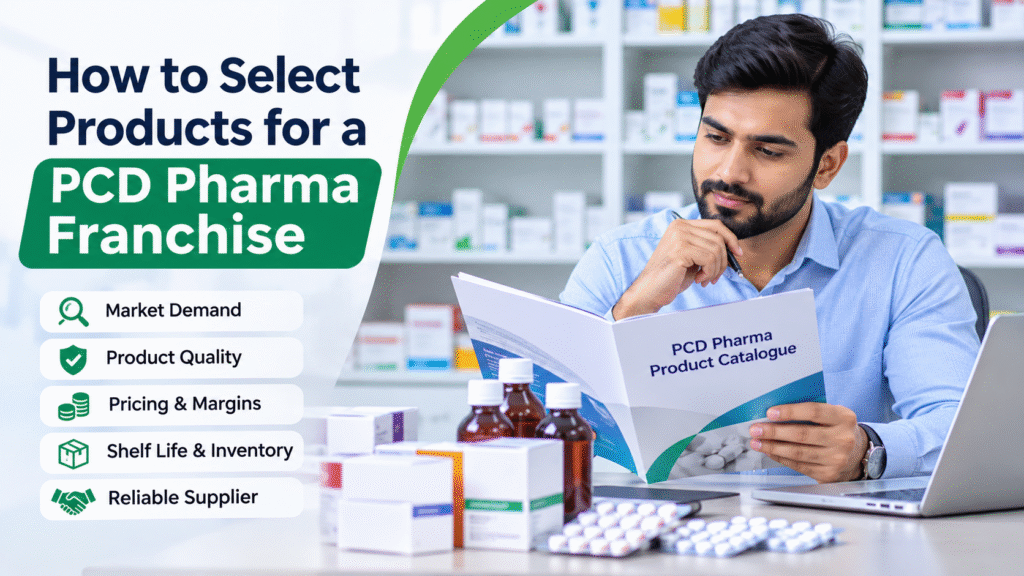
Why Is Product Selection Important in a PCD Pharma Franchise?
Product selection influences several important aspects of a pharmaceutical franchise business, including stock movement, operating costs, customer relationships and working capital.
A distributor who purchases too many unfamiliar formulations may face difficulties with unsold inventory, expiry dates and delayed payments.
On the other hand, selecting products that match verified customer requirements can help create a more manageable distribution operation.
The most practical way to select products for a PCD pharma franchise is to research your market, choose relevant therapeutic categories, verify product documentation, evaluate pricing and plan inventory according to realistic demand.
The objective should be to build a focused and compliant pharmaceutical portfolio rather than purchasing every available medicine from a supplier’s catalogue.
How to Select Products for a PCD Pharma Franchise: 10 Essential Steps
There is no universal product list that works equally well for every pharmaceutical distributor. Market requirements, available capital, therapeutic specialisation and operational capabilities differ from one business to another.
The following steps provide a structured approach to pharmaceutical franchise product selection.
Step 1: Research Your Local Pharmaceutical Market
Before purchasing medicines, understand the requirements of the geographical market you intend to serve.
Pharmaceutical distribution conditions may vary between metropolitan cities, smaller towns and rural markets.
For example, a distributor serving an established network of general medicine retailers may have different product requirements from a business focused on dermatology or pediatric formulations.
Identify Your Target Customers
Review the licensed pharmaceutical businesses and other authorised customers relevant to your proposed operation.
If you already operate a wholesale business, historical purchase records and customer enquiries can help identify relevant product categories.
New distributors without previous sales data should begin with conservative estimates rather than assuming that every product will sell quickly.
Understand Local Competition
Examine whether similar formulations are already available through existing pharmaceutical distributors.
Competition may influence pricing, customer acquisition and stock movement. However, it should be evaluated alongside product relevance, supplier reliability and commercial terms.
Check Actual Product Requirements
Where appropriate, use purchasing records, lawful trade enquiries and discussions with authorised customers to understand which product categories may be relevant.
Reliable business information is more useful than unsupported promotional claims about fast-moving medicines.
Step 2: Select Suitable Pharmaceutical Therapeutic Categories
Choosing the appropriate therapeutic categories is an important part of how to select products for a PCD pharma franchise.
Pharmaceutical companies may market products across general medicine, gastroenterology, orthopaedic, dermatology, pediatric, gynaecology and other segments.
Each category may involve different formulations, storage requirements and distribution considerations.
| Product Category | Common Dosage Forms | Key Considerations |
|---|---|---|
| General Medicine | Tablets, capsules, syrups | Customer requirements and inventory turnover |
| Gastroenterology | Tablets, capsules, suspensions | Composition, packaging and product availability |
| Orthopaedic | Tablets, capsules, topical gels | Product relevance and prescription controls |
| Pediatric | Dry syrups, suspensions, drops | Labelling and storage requirements |
| Dermatology | Creams, gels, lotions, ointments | Packaging integrity and remaining shelf life |
| Gynaecology | Selected oral and nutritional formulations | Relevant product documentation |
| Anti-Infective | Tablets, capsules, dry syrups | Responsible prescription medicine distribution |
| Nutraceutical | Softgels, powders, nutritional liquids | Applicable product classification and label claims |
| Injectable | Injections and infusions | Specialised storage and regulatory requirements |
These are general pharmaceutical product categories. The actual formulations available depend on the pharmaceutical company and its current product portfolio.
New distributors should prioritise therapeutic categories that match their existing business knowledge, target customers and inventory-handling capabilities.
Step 3: Verify Medicine Composition, Strength and Dosage Form
Once you have identified suitable therapeutic categories, evaluate the individual pharmaceutical formulations.
Medicines within the same therapeutic segment may differ in their active ingredients, strengths, dosage forms and approved uses.
Review Product Composition
Check the ingredients and strengths listed on the current approved packaging.
Do not assume that medicines with similar brand names contain identical formulations.
For combination medicines, verify the complete composition and applicable product documentation.
Understand Dosage Form Requirements
Tablets, capsules, suspensions, dry syrups and injections can have different storage and handling requirements.
Only select products that your business is legally authorised and operationally equipped to distribute.
Examine Packaging Details
Confirm pack sizes, labelling, batch information, expiry dates and storage instructions.
Packaging differences may influence purchasing costs, stock management and the fulfilment of customer orders.
Step 4: Check Pharmaceutical Manufacturing Quality
Product authenticity, quality documentation and regulatory compliance should be central to the selection process.
Before purchasing medicines, review the manufacturing company identified on the product packaging.
Pharmaceutical marketing companies may work with third-party manufacturers. Therefore, the marketing company’s name and the actual manufacturing entity may be different.
Verify Manufacturing Information
Ask for relevant manufacturing licence details and supporting product information where appropriate.
Do not assume that every product sold by a pharmaceutical marketing company comes from the same manufacturing facility.
Review Quality Documentation
Depending on the product and business arrangement, relevant information may include approved labels, manufacturing authorisations and available batch-related quality records.
Certifications and quality claims should only be relied upon when they are authentic and applicable to the relevant facility or product.
Maintain Product Traceability
Batch numbers, manufacturing dates, expiry dates and purchase records are important for stock management and product complaints.
Appropriate traceability also supports the handling of product recalls where required.
For official pharmaceutical regulatory information, consult the Central Drugs Standard Control Organisation.
Step 5: Evaluate Product Shelf Life and Expiry Risk
Expiry management is one of the most important practical considerations for pharmaceutical distributors.
A medicine may have attractive commercial terms, but a short remaining shelf life can increase the risk of unsold stock.
Check Remaining Shelf Life
Before accepting an order, review the expiry information of the actual stock being supplied.
Do not rely only on the original shelf life mentioned in a general product specification.
Estimate Realistic Stock Movement
Use available business records and reasonable demand estimates to determine appropriate purchasing quantities.
When demand is uncertain, smaller opening orders may be more suitable, depending on the supplier’s minimum order requirements.
Use Appropriate Stock Rotation
First-expiry-first-out inventory management can help prioritise products with earlier expiry dates.
Maintain batch-wise stock records and review products approaching expiry regularly.
Understand Product Replacement Policies
Ask whether the pharmaceutical company offers any return or replacement arrangements for damaged, short-dated or unsold stock.
Such conditions should be confirmed in writing because policies vary between suppliers.
Step 6: Compare Product Pricing and Profit Margins
Pricing is important when deciding how to select products for a PCD pharma franchise, but the lowest purchase price does not necessarily offer the best commercial value.
Product profitability depends on several factors, including the purchase cost, realised selling price, stock movement, freight and operating expenses.
Understand Gross Margin
Gross margin helps estimate the difference between net selling revenue and the associated cost of goods sold.
Gross Margin (%) = (Net Selling Revenue – Cost of Goods Sold) / Net Selling Revenue x 100
For example, assume a product has net selling revenue of Rs. 100 and a cost of goods sold of Rs. 75.
The gross margin would be 25% before other operating expenses.
This is an illustrative calculation and does not represent an actual Adegen Pharma product quotation or guaranteed commercial margin.
Consider Additional Expenses
Freight, warehousing, employee costs, administration, product returns and customer credit can affect final profitability.
A product with an attractive gross margin may still be commercially unsuitable if inventory moves slowly or operating expenses are excessive.
Compare Quotations Carefully
Ensure that supplier quotations are compared using consistent pack sizes, quantities and applicable tax treatments.
Review payment terms and other commercial conditions before finalising an order.
Step 7: Plan Your Initial Pharmaceutical Product Inventory
A common challenge for new pharmaceutical distributors is deciding how many products to include in the initial catalogue.
There is no universal number that applies to every franchise business.
The appropriate starting range depends on working capital, confirmed purchasing requirements and the distributor’s ability to manage inventory.
Classify Products According to Business Priority
A simple product priority system can help organise purchasing decisions.
| Priority | Selection Criteria | Suggested Approach |
|---|---|---|
| High | Verified customer requirements and suitable supply conditions | Consider for initial purchasing |
| Medium | Potential demand with limited purchasing history | Evaluate with cautious quantities |
| Low | Uncertain demand or unsuitable inventory conditions | Defer until requirements become clearer |
This is an illustrative business planning method rather than an industry-wide product ranking.
Review Product Movement
After starting distribution, monitor actual customer orders, stock movement, outstanding payments and remaining shelf life.
Use this information to decide which products require replenishment and whether additional formulations should be considered.
Step 8: Evaluate Your PCD Pharma Franchise Supplier
Reliable communication and transparent commercial conditions are important when choosing a pharmaceutical supplier.
Before entering a franchise arrangement, request information about product availability, ordering procedures and supplier responsibilities.
Important questions include:
- Which pharmaceutical products are currently available?
- What are the minimum order quantities?
- Are updated product catalogues and quotations available?
- How are orders processed and dispatched?
- What freight and payment conditions apply?
- What is the policy for damaged or short-dated products?
- Can relevant manufacturing documentation be provided?
- Are any exclusive distribution territories available?
- Which promotional materials or business support services are included?
Commercial commitments should be confirmed through appropriate written agreements.
Distributors exploring different pharmaceutical categories can also review Adegen Pharma’s PCD Pharma Franchise List in India for further business information.
Step 9: Verify Pharmaceutical Licensing Requirements
Regulatory eligibility is essential before selecting medicines for commercial distribution.
Pharmaceutical wholesale businesses generally require appropriate authorisation under the applicable drug regulations.
Different pharmaceutical product categories and activities may involve separate licensing or handling requirements.
For example, wholesale licences such as Form 20B and Form 21B may apply to relevant drug categories under India’s regulatory framework.
The exact authorisation required should be confirmed with the competent state drug licensing authority.
India’s pharmaceutical regulatory framework includes the Drugs and Cosmetics Act, 1940 and the Drugs Rules, 1945, together with applicable amendments.
Refer to the CDSCO official website for regulatory information.
Products classified as food supplements or nutraceuticals may be subject to different applicable requirements, which should be verified separately.
Step 10: Use a Product Selection Scorecard
A structured scorecard can help distributors compare shortlisted formulations before placing a purchase order.
Consider market relevance, supplier reliability, inventory suitability, commercial viability and compatibility with the existing portfolio.
| Evaluation Factor | Suggested Weight | Evaluation Criteria |
|---|---|---|
| Market Relevance | 30% | Evidence of genuine customer requirements |
| Supplier Reliability | 20% | Stock availability and fulfilment conditions |
| Inventory Suitability | 20% | Shelf life, storage and order quantities |
| Commercial Viability | 20% | Total expenses and realistic business economics |
| Portfolio Compatibility | 10% | Compatibility with existing product categories |
These percentages are illustrative planning weights and not established pharmaceutical industry benchmarks.
Regulatory legality, authentic documentation and product quality should be treated as mandatory requirements rather than factors that can be compensated for by higher commercial scores.
Common Mistakes When Selecting PCD Pharma Franchise Products
Understanding how to select products for a PCD pharma franchise also involves identifying mistakes that can create unnecessary financial or operational difficulties.
Purchasing Too Many Products
Ordering a large product range without reliable demand information can increase inventory costs and expiry exposure.
Focusing Only on Trade Discounts
A high trade discount does not necessarily mean that a product will generate greater net profit.
Consider actual stock movement, total expenses and customer payment conditions.
Ignoring Product Expiry Dates
Short remaining shelf life can increase the risk of unsold stock.
Check the expiry details of actual batches before accepting inventory.
Not Verifying Manufacturing Information
Pharmaceutical product documentation and manufacturer details should be reviewed before purchasing.
Do not rely exclusively on broad promotional claims.
Assuming Franchise Monopoly Rights
A PCD franchise arrangement does not automatically provide exclusive geographical rights.
Any proposed territorial exclusivity should be agreed upon and documented separately.
Explore PCD Pharma Franchise Products with Adegen Pharma
Adegen Pharma Pvt. Ltd. is a pharmaceutical company based in Sector 20, Panchkula, Haryana.
The company provides information about PCD pharma franchise opportunities and markets pharmaceutical products across multiple dosage categories.
Its published portfolio includes tablets, capsules, softgel capsules, syrups, dry syrups, suspensions, injections, infusions, drops, creams, gels, ointments and nutritional formulations.
Prospective distributors can explore these categories according to their market requirements and business plans.
Pharmaceutical Product Range
Adegen Pharma’s published catalogue provides information about different pharmaceutical formulations.
Interested franchise associates should request the latest product list to verify current availability, packaging, compositions and commercial terms.
PCD Franchise Business Enquiries
The company promotes pharmaceutical franchise-related services for prospective business associates.
Applicants can enquire about available products, relevant business documentation and applicable commercial arrangements.
Third-Party Pharmaceutical Manufacturing
Adegen Pharma also provides information about third-party pharmaceutical manufacturing.
This is a different business arrangement from pharmaceutical franchise distribution and should be evaluated according to the customer’s specific requirements.
When considering how to select products for a PCD pharma franchise with Adegen Pharma, prospective associates should focus on the current product catalogue, manufacturing information, suitable dosage categories and written commercial terms.
Frequently Asked Questions About PCD Pharma Product Selection
1. How to select products for a PCD pharma franchise?
Start by researching your target market and identifying relevant customer requirements. Select suitable therapeutic categories and compare individual formulations based on approved composition, manufacturing documentation, pricing, shelf life and supplier reliability. A manageable product range supported by realistic demand information is generally preferable to ordering an extensive, untested catalogue.
2. Which products are suitable for a new PCD pharma franchise?
The most suitable products depend on the distributor’s market, customer network, experience and regulatory eligibility. Tablets, capsules, syrups, topical medicines and other formulations may be considered according to genuine requirements. There is no universal list of products that guarantees commercial success in every pharmaceutical market.
3. How many products should I select when starting a pharmaceutical franchise?
There is no fixed product count that suits every distributor. The opening portfolio should reflect available working capital, customer requirements, minimum order quantities and inventory management capabilities. Starting with a manageable selection allows the business to evaluate actual product movement before expanding into additional formulations.
4. How can I reduce expiry losses in a pharmaceutical franchise?
Review the remaining shelf life of products before purchasing, maintain batch-wise inventory records and follow appropriate stock rotation procedures. Order quantities should be based on realistic demand. It is also important to clarify the supplier’s return and replacement conditions, since not every company offers the same policies.
5. Should I choose PCD franchise products based on profit margins?
Profit margins are relevant, but they should not be the only consideration. Evaluate stock turnover, freight, storage expenses, customer credit and expiry risks. A product with a higher quoted margin may be less commercially suitable when demand is uncertain or additional operating costs are significant.
6. What documents should I verify before purchasing pharmaceutical products?
Check the current approved product label, composition, manufacturer information, applicable licensing details, batch records, expiry dates and storage requirements. Also request an updated quotation and clarify minimum orders, freight responsibilities and product replacement policies. Ensure your business has the appropriate authorisation for its intended activities.
7. How can I request a PCD pharma franchise product list from Adegen Pharma?
Contact Adegen Pharma through its official website or business enquiry details. Share your location, preferred product categories, pharmaceutical business experience and applicable licensing status. Request the latest catalogue, product information and current commercial terms to evaluate whether the company’s offerings match your distribution requirements.
Conclusion: Build a Practical Pharmaceutical Product Portfolio
Learning how to select products for a PCD pharma franchise involves more than reviewing pharmaceutical company catalogues or comparing purchase prices.
A responsible product-selection process includes market research, verification of pharmaceutical documentation, careful evaluation of product categories and realistic inventory planning.
Distributors should consider stock turnover, remaining shelf life, supplier reliability and overall operating expenses before placing significant purchase orders.
Choosing products that match genuine business requirements can support more efficient inventory management and informed commercial decision-making.
Request a PCD Pharma Franchise Product Catalogue from Adegen Pharma
If you are planning to start a pharmaceutical franchise or expand an existing medicine distribution business, Adegen Pharma Pvt. Ltd. provides information about its pharmaceutical product portfolio and franchise-related services.
Eligible distributors, wholesalers, stockists and entrepreneurs can contact the company to discuss available product categories and business requirements.
Adegen Pharma Pvt. Ltd.
Business Location: Sector 20, Panchkula, Haryana, India
Primary Phone: +91 8907000011
Additional Numbers: +91 9896771850 | +91 9306250481
Email: adegenpharma@gmail.com
Website: https://www.adegenpharma.com/
Business Enquiry: Contact Adegen Pharma
Explore Pharmaceutical Product Categories and Request the Latest PCD Franchise Product Catalogue.
Disclaimer: This article is intended for pharmaceutical business information. Product availability, manufacturing documentation, commercial terms and applicable licences must be verified before entering a franchise arrangement. No guaranteed sales, profitability or territorial exclusivity is implied. Prescription medicines must be marketed and distributed responsibly in accordance with applicable laws.